Tell us about the job
Takes about a minute. No obligation.
Electric water heaters fail in predictable ways: the heating elements corrode, the thermostats drift, and the anode rod depletes quietly until sediment takes over the tank. Electricity heats more occupied homes in Dorchester County, Maryland than any other fuel, at 53.1% (2020-2024 ACS 5-year). That majority matters for repair work because it narrows what a contractor looks at first. Combustion faults, venting blockages, and gas valve failures are off the table. The contractor checks element resistance with a meter, pulls the thermostat, and inspects the sacrificial rod. Those components carry every cycle the unit has run, and in a home that has never had a burner, they are the whole story.
A water heater sitting in a house that has cycled through several systems before it carries a particular kind of accumulated burden: mineral deposits in the tank, corrosion at the flue collar, and supply lines that were sized and fitted for something else. Half the homes in Dorchester County, Maryland were built in 1975 or earlier (2020-2024 ACS 5-year). Stock that old has had enough time to layer these conditions in ways that are not visible from outside the unit. When a contractor opens the access or pulls the anode rod, what they find decides whether the repair is a straightforward part swap or whether the surrounding plumbing changes the scope entirely.
The Parts of a Water Heater a Contractor Checks First
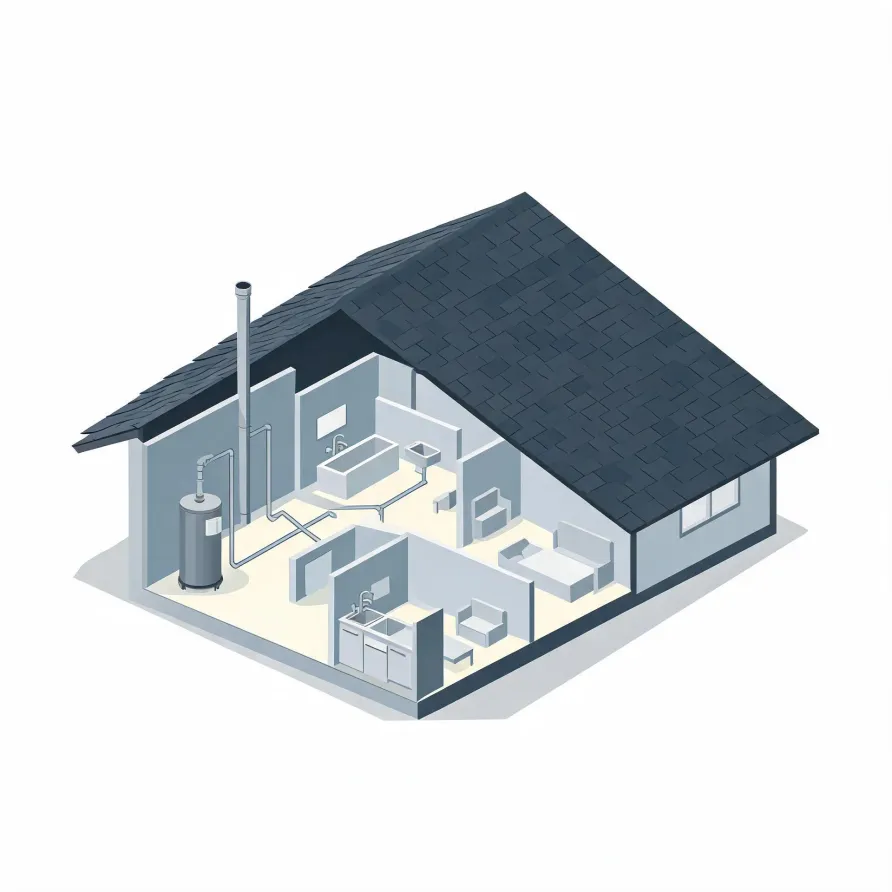
The tank is the piece a homeowner notices first, usually standing in a basement, utility closet, or garage. It holds and heats the water supply for the whole house. When something has gone wrong, the tank itself, its insulation, and the pressure relief valve mounted to its side are among the first things a contractor looks at.
The burner assembly or heating element sits at the base or interior of the tank depending on whether the unit runs on gas or electricity, and the thermostat that controls it is mounted directly to the tank body. The dip tube carries cold water in, and the anode rod runs down through the tank to slow corrosion from the inside out. Each of these can be the source of a problem.
The drawing shows a representative layout, and a licensed contractor determines what applies to the specific unit and installation in your home.
Get matched in Dorchester CountyDorchester County by the numbers
85 severe weather events were recorded in Dorchester County, Maryland between 2015 and 2024.
NOAA National Centers for Environmental Information, Storm Events Database, bulk CSV export, events 2015-01-01 through 2024-12-31.Half the homes in Dorchester County, Maryland were built in 1975 or earlier (2020-2024 ACS 5-year).
U.S. Census Bureau, 2020-2024 American Community Survey 5-Year EstimatesDorchester County, Maryland holds 16,433 housing units (2020-2024 ACS 5-year).
U.S. Census Bureau, 2020-2024 American Community Survey 5-Year EstimatesOwners occupy 65.6% of the occupied homes in Dorchester County, Maryland (2020-2024 ACS 5-year).
U.S. Census Bureau, 2020-2024 American Community Survey 5-Year EstimatesCodes & Standards Behind Water Heater Repair in Dorchester County, Maryland1 sourced rules and standards
Licensing Rules for HVAC Repair in Dorchester County, Maryland
Maryland requires a state licence before an individual provides, or assists in providing, heating, ventilation, air-conditioning or refrigeration services.
Severe Weather Events in Dorchester County
Extreme weather puts real strain on water heaters, pushing them to run harder and recover faster than they would on mild days. How much of that pressure a unit in Dorchester County faces is a local question, and the record below reflects it.
85 severe weather events, 2015–2024. Source: NOAA National Centers for Environmental Information, Storm Events Database.