Tell us about the job
Takes about a minute. No obligation.
Electric water heaters run every day of the year, but the fuel mix in a county shapes what a contractor expects to find inside a struggling unit. Electricity heats more occupied homes in Harford County, Maryland than any other fuel, at 42.3% (2020-2024 ACS 5-year). With electricity as the dominant source, most water heaters here rely on resistance heating elements rather than a burner or heat exchanger, and those elements fail in predictable ways: sediment builds on them, the thermostat that controls them drifts, and the anode rod that protects the tank from corrosion wears down. A contractor diagnosing a failing unit in this county checks the elements and thermostat first, because that is where the wear lands.
Water heaters in houses this old are often on their second or third unit, but the plumbing connections and venting around them date to the original build, and a contractor working on a repair has to account for both. Half the homes in Harford County, Maryland were built in 1986 or earlier (2020-2024 ACS 5-year). A unit that age can carry sediment layers thick enough to shorten the remaining life of a heating element, and the anode rod, if it has never been replaced, is frequently consumed past the point where it offers any protection. What the contractor finds once the unit is open determines whether the repair is a straightforward part swap or whether the parts the system takes are still in production.
The Parts of a Water Heater a Contractor Checks First
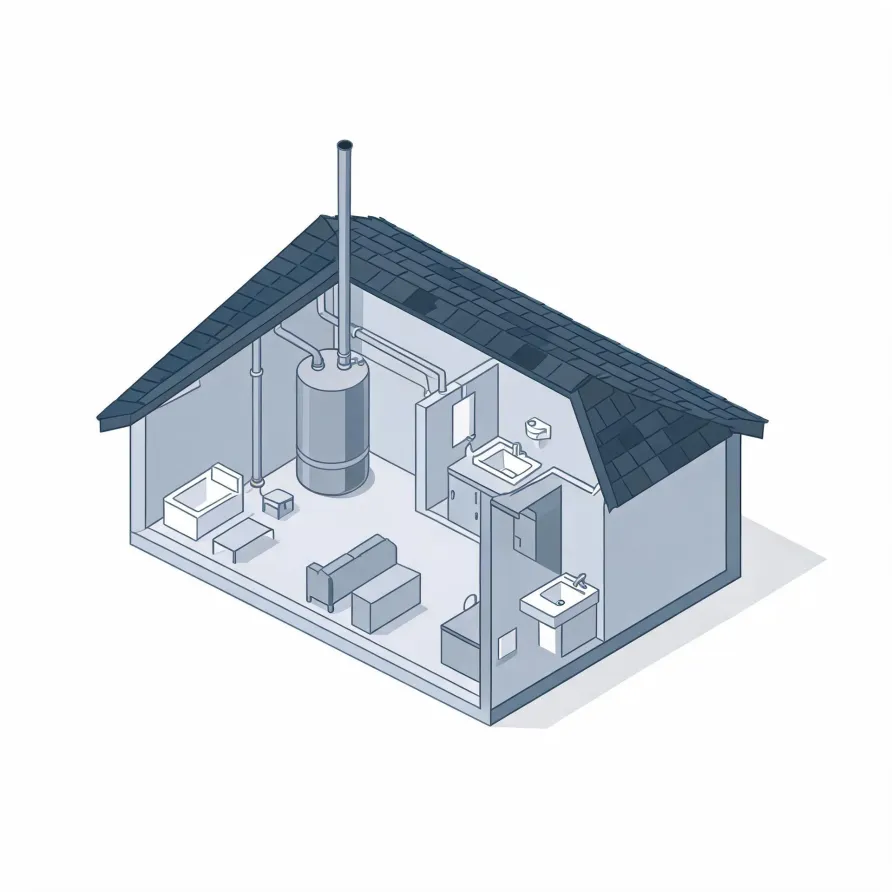
The tank is what most homeowners notice, a large insulated cylinder that sits in a basement, utility closet, or garage and holds a ready supply of hot water. The burner assembly or heating element sits at the base or inside the tank and does the actual heating. When either fails, the water comes out cold or never reaches temperature.
The pressure relief valve mounts on the side of the tank and opens automatically if pressure or temperature climbs too high. The anode rod hangs inside the tank to slow corrosion of the metal walls. The dip tube carries cold supply water to the bottom of the tank, and the flue or exhaust vent runs upward from gas-fired units to carry combustion gases out of the house.
The drawing shows the general layout of a water heater system, and a licensed contractor determines what applies to the specific unit and installation in your home.
Get matched in Harford CountyHarford County, by the numbers
368 severe weather events were recorded in Harford County, Maryland between 2015 and 2024.
NOAA National Centers for Environmental Information, Storm Events Database, bulk CSV export, events 2015-01-01 through 2024-12-31.Half the homes in Harford County, Maryland were built in 1986 or earlier (2020-2024 ACS 5-year).
U.S. Census Bureau, 2020-2024 American Community Survey 5-Year EstimatesHarford County, Maryland holds 105,468 housing units (2020-2024 ACS 5-year).
U.S. Census Bureau, 2020-2024 American Community Survey 5-Year EstimatesOwners occupy 79.7% of the occupied homes in Harford County, Maryland (2020-2024 ACS 5-year).
U.S. Census Bureau, 2020-2024 American Community Survey 5-Year EstimatesWater Heater Repair Rules & Standards for Harford County, Maryland1 sourced rules and codes
Licensing Rules for HVAC Repair in Harford County, Maryland
Maryland requires a state licence before an individual provides, or assists in providing, heating, ventilation, air-conditioning or refrigeration services.
Severe Weather Events in Harford County
Harford County weather puts real stress on water heaters: pressure fluctuations, power surges, and hard temperature swings all shorten a unit's working life and push it toward failure sooner than age alone would. That pattern makes repair and service needs here a local question, not a general one.
368 severe weather events, 2015–2024. Source: NOAA National Centers for Environmental Information, Storm Events Database.